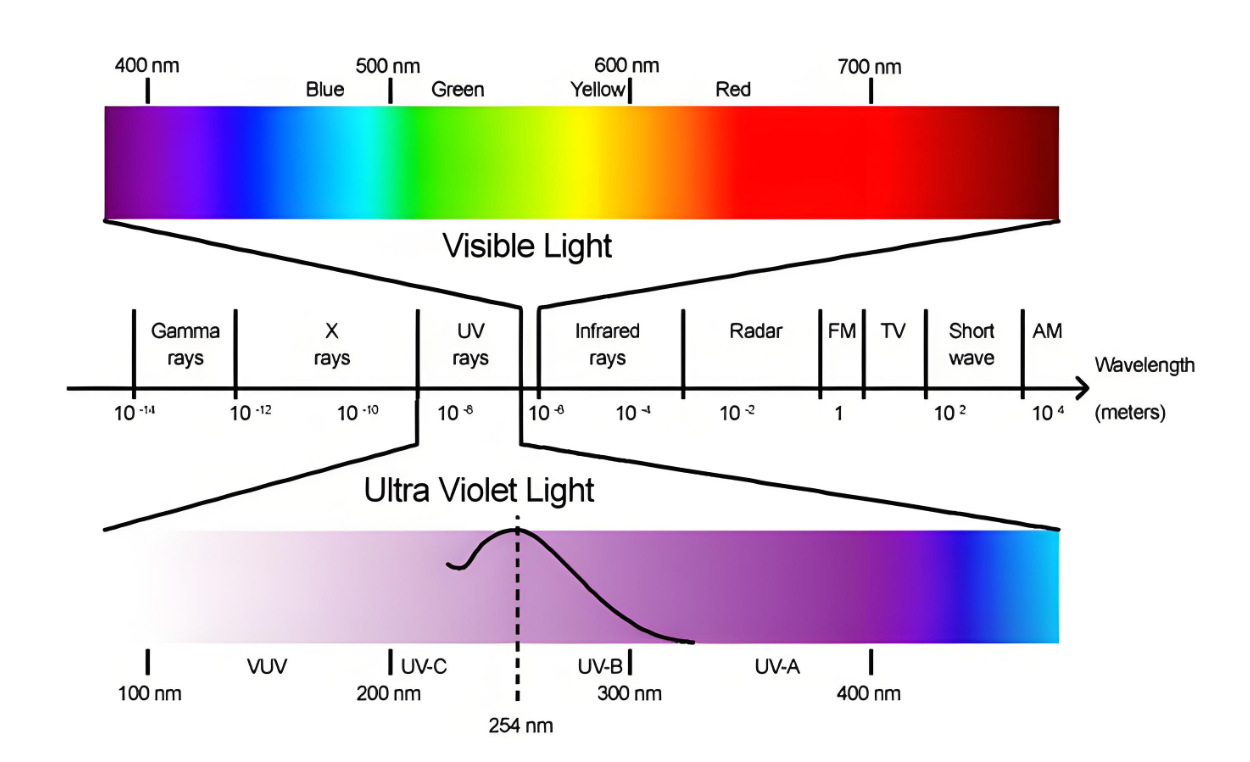
Ultraviolet disinfection is a photochemical process. Its core principle is to irradiate microorganisms with ultraviolet light within a specific wavelength range, destroying the genetic material within their cells—nucleic acids (DNA or RNA), thereby preventing the replication and reproduction of the microorganisms and ultimately achieving inactivation.
In the ultraviolet spectrum, the UVC band (usually 200-280nm) has the strongest bactericidal effect. The wavelength of approximately 254nm (generated by traditional low-pressure mercury lamps) closely matches the peak of the ultraviolet absorption spectrum of microbial DNA, making it particularly effective in damaging DNA.
When ultraviolet energy is absorbed by nucleic acids, it causes strand breaks and forms photochemical products such as pyrimidine dimers. These structural damages interfere with normal DNA replication and transcription, rendering the microorganisms inactive or unable to reproduce.
The effectiveness of ultraviolet disinfection is determined by the UV dose (UV dose or fluence), typically measured in millijoules per square centimeter (mJ/cm²) or microwatt seconds per square centimeter (uW·s/cm²).
UV dose is the product of UV intensity (Irradiance, measured in mW/cm² or uW/cm²) and the effective exposure time (exposure time, measured in seconds) of microorganisms under UV light.
Adequate UV dose is crucial for effectively inactivating target microorganisms. Different microorganisms have varying sensitivities to UV light, requiring different doses to achieve the desired inactivation rate.
品 名 | 99.9% 杀菌率剂量 μw.s/cm2 | 品 名 | 99.9%杀菌率剂量μw.s/cm2 |
BACTERIA(细菌) |
| MOLD SPORES (霉菌芽孢) |
|
Bacillus anthracis 炭疽杆菌 | 8700 | Mucor ramosissimus A 多分枝毛霉菌 | 35200 |
Clostridium tetani 破伤风杆菌 | 22000 | Penicillum roqueforti(olive) | 22000 |
Escherichkia coli 大肠杆菌 | 6600 | VIRUSES (病毒) |
|
Mycobacterium tuberculsis 结核分枝杆菌 | 10000 | Coliphage 大肠杆菌噬菌体 | 6600 |
Dysentery bacilli 痢疾杆菌 | 4200 | Bacteriophage(E.coli) 噬菌体 | 6600 |
Salmonella enteritidis 沙门氏肠炎菌 | 7600 | Virux of infectious hepatitus 肝炎病毒 | 8000 |
Staphylococcus aureus 金黄色葡萄球菌 | 6600 | lntluenza virus 感冒病毒 | 6600 |
Staphylococcus faecalis 粪便葡萄球菌 | 10000 | Pollo virus 脊髓灰质炎病毒 | 6000 |
Vibrio cholerae 霍乱弧菌 | 6500 |
|
|
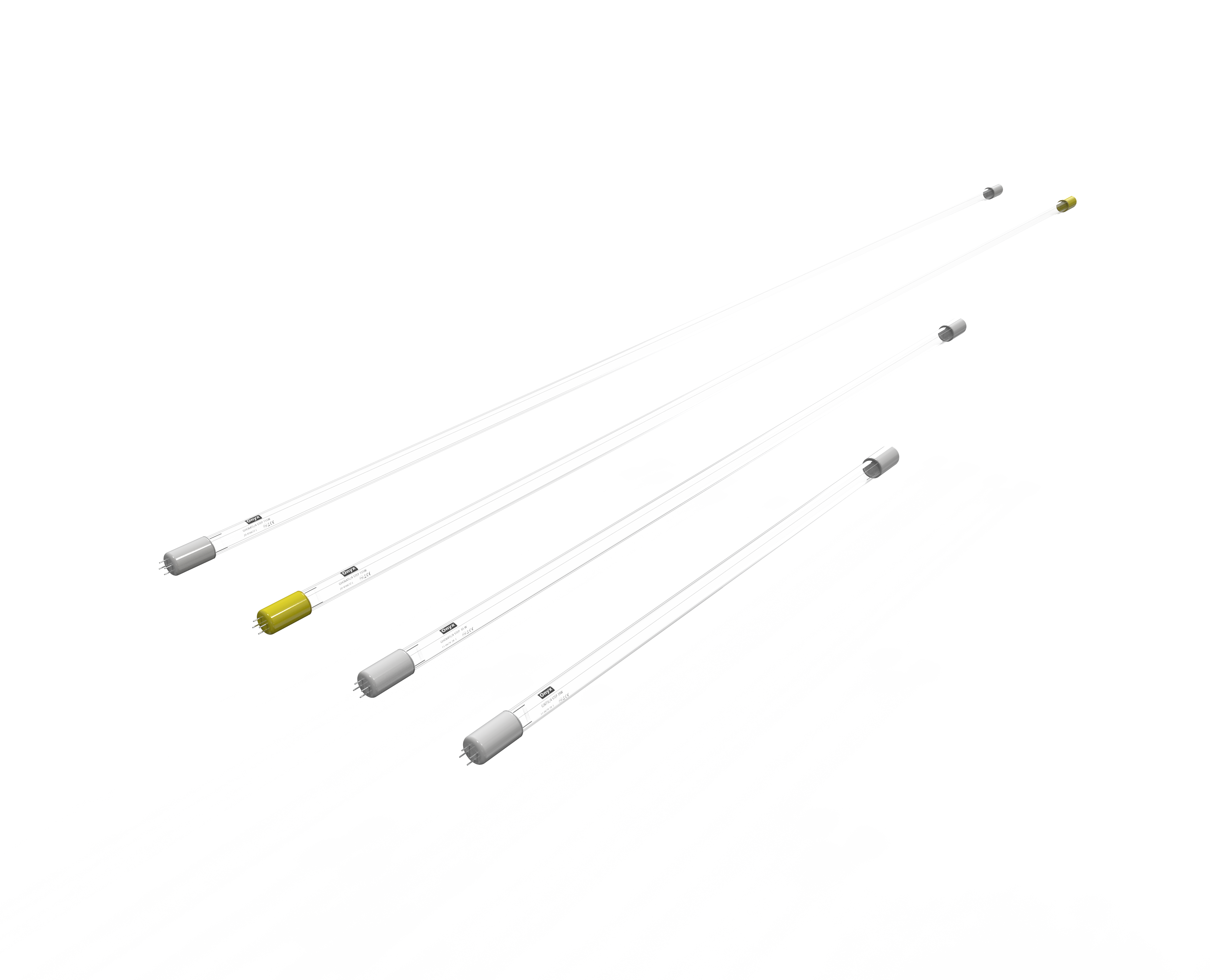
There are two main types of UV lamps:
·Low-Pressure Mercury Lamps: These primarily emit nearly monochromatic 254nm UV light, which closely matches the absorption peak of microbial DNA. This results in high sterilization efficiency and electro-optical conversion efficiency (up to 30-40%). Low-pressure mercury lamps offer a relatively long lifespan and low operating costs, making them widely used in water treatment facilities of all sizes. Based on power output, they can be categorized as standard low-pressure lamps, low-pressure high-intensity (LPHO) lamps, and low-pressure amalgam lamps.
·Medium-Pressure Mercury Lamps: These emit polychromatic, broad-spectrum UV light (200-400nm). The power per lamp is significantly higher than that of low-pressure lamps. The high power density of medium-pressure lamps makes them advantageous for treating large water flows, but their electro-optical conversion efficiency is relatively low (approximately 10-15%), and their lamp life is also shorter.
The UV kill rate and dose sensitivity of different microorganisms vary significantly.
Photoreactivation: After UV irradiation, certain microorganisms (primarily bacteria) are activated by photolyases (photolyases) when exposed to visible light (particularly blue light, 300-500 nm). These enzymes can specifically repair pyrimidine dimers caused by UV radiation, restoring DNA function.
Dark Repair: This is a light-independent repair mechanism that removes or repairs DNA damage through a series of enzymatic reactions (such as excision repair and recombination repair).
The existence of these repair mechanisms means that if the effluent water after UV disinfection is subjected to suitable conditions (such as light exposure and long residence time), microbial resuscitation may occur, compromising disinfection effectiveness.
In engineering design, a safety margin is often required, or other disinfection methods (such as chlorination to provide residual chlorine in the pipeline network) must be combined to inhibit microbial repair.
UV transmittance (UVT) is a measure of the ability of a water sample to transmit UV light at a specific wavelength (usually 254 nm) and directly reflects the water's absorption of UV light.
The lower the UVT value, the faster the UV light decays in water, the shorter the effective disinfection distance, and the higher the UV lamp power required to achieve the target dose.

Bioassay for UV disinfection is the internationally recognized gold standard for verifying the actual disinfection performance of UV reactors (i.e., the delivered effective dose (RED)). This method uses challenge microorganisms with known UV dose-response relationships (such as MS2 bacteriophage and Bacillus subtilis spores) to conduct tests under actual flow conditions, thereby inferring the reactor's dose delivery capability.
Online Sensor Monitoring and Dose Calculation: Daily water plant operations rely heavily on data from online UV intensity sensors and flow meters, combined with dose calculations derived from empirical formulas or CFD models.

 WSH紫外明渠
WTV紫外垂直模块
ZL大型管道式紫外
CLEAR中压紫外
MOL板式臭氧发生器
UV-AOP高级氧化
D.FITE滤布滤池
WSH紫外明渠
WTV紫外垂直模块
ZL大型管道式紫外
CLEAR中压紫外
MOL板式臭氧发生器
UV-AOP高级氧化
D.FITE滤布滤池